
Checking RFK Jr.’s math about how to calculate percentages
President Donald Trump has regularly said that drug-price discounts on his watch are greater than 100%, which isn’t mathematically possible. Now his health and human services secretary, Robert F. Kennedy Jr., is trying to back up his faulty math.
During an April 22 Senate Finance Committee hearing, Sen. Elizabeth Warren, D-Mass., questioned Kennedy about discounts available on the federally run TrumpRx website. She expressed doubt about Trump’s past statements about price reductions up to 600%.
Kennedy said, “President Trump has a different way of calculating percentages. There’s two ways of calculating percentages. If you have a $600 drug and you reduce it to $10, that’s a 600% reduction.”
RFK Jr: “President Trump has a different way of calculating percentages. If you have a $600 drug and you reduce it to $10, that’s a 600% reduction.” pic.twitter.com/MjDNADqc8p
— Aaron Rupar (@atrupar) April 22, 2026
In an Oval Office event the following day, Kennedy brought up the exchange with Warren and reiterated his statement.
“If the drug was $100 and it raised the price to $600 that would be a 600% rise,” Kennedy said. “If it drops from $600 to $100, that’s a 600% savings. And the President used that mathematical device to illustrate the magnitude of the theft that has been happening against our country and our people.”
But well-established mathematical principles have only one way to calculate percentage change, and neither Trump nor Kennedy did it correctly.
In Kennedy’s example to Warren during the Senate Finance Committee hearing, if a drug was reduced from $600 to $10, that would represent a 98.3% decrease, not a 600% decrease. Specifically, to calculate that percentage decrease, you would subtract $10 from $600 and divide the answer ($590) by the original price, $600. In Kennedy’s case, $590 divided by $600 equals .983, or 98.3%.
“It’s mathematically impossible” for the reduction to be higher than 100% and for the consumer to still have to pay something, said Maryclare Griffin, associate professor in the University of Massachusetts-Amherst’s mathematics and statistics department.
The Department of Health and Human Services did not respond to an inquiry for this article.
Trump has made similar claims before — citing decreases as high as 1,000% — but price cuts this large are not mathematically possible.
In August, when The Associated Press fact-checked an earlier instance of Trump making a similar statement, the White House did not explain or justify the underlying math. At the time, White House spokesman Kush Desai said, “It’s an objective fact that Americans are paying exponentially more for the same exact drugs as people in other developed countries pay, and it’s an objective fact that no other Administration has done more to rectify this unfair burden for the American people.”
A 100% reduction would mean that a consumer pays nothing for a medication.
A 200% reduction would mean the pharmaceutical company pays the consumer the full price of the medicine.
A 400% reduction would mean the company pays the consumer three times the price of the medicine.
A 500% cut would bring the consumer four times the price, and a 600% cut would give the consumer five times the price to accept the medicine. Any of these decreases are unrealistic.
“There’s no other way to calculate percentage change, and Trump’s way is not a valid way,” said Brooke Nichols, a mathematical modeler and health economist at Boston University’s School of Public Health. “The maximum amount a price can decrease is by 100%. It’s possible to increase a price by 600%, but it doesn’t work the other way around.”
Our ruling
Kennedy said, “There’s two ways of calculating percentage” decreases. “If you have a $600 drug and you reduce it to $10, that’s a 600% reduction.”
That’s not how percentage decreases work. For anything higher than a 100% decrease in price, the seller would be paying the customer to possess the drug.
In Kennedy’s example to Warren, a $590 reduction in the price of a $600 drug would represent a 98.3% decrease, not a 600% decrease.
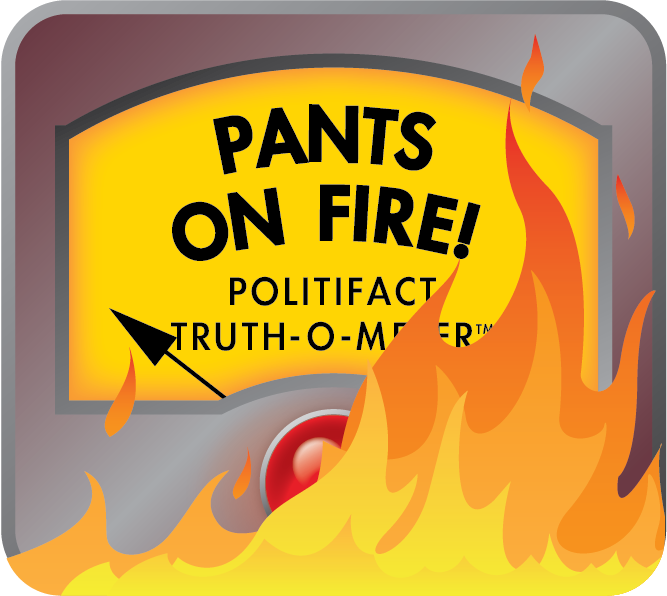
We rate the statement Pants on Fire!
PolitiFact Staff Writer Grace Abels contributed to this report.


