Fact-checking Michigan Democratic Senate debate
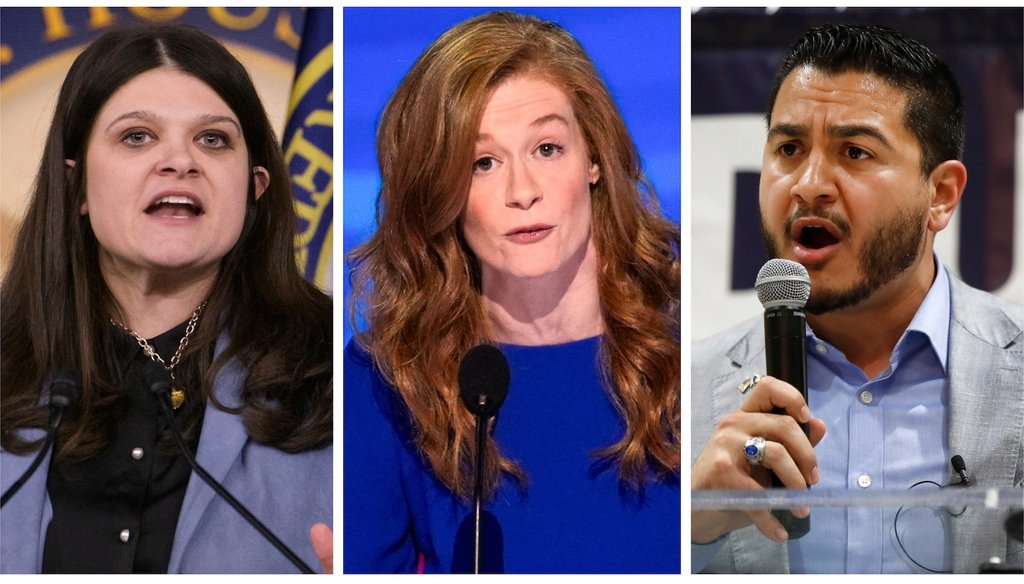
Three Democrats vying for their party’s U.S. Senate nomination in Michigan sparred over campaign finance, foreign policy and state business development during a May 28 debate.
During the Mackinac Policy Conference debate, the candidates presented competing visions about who is best situated to face Republican Mike Rogers in the November election, and for the direction of the Democratic Party. Michigan’s primary election is scheduled for Aug. 4.
We fact checked some of the statements from candidates Abdul El-Sayed, a former public health official, state Sen. Mallory McMorrow and U.S. Rep. Haley Stevens.
El-Sayed: “I’m the only candidate on the stage who has never taken a dime from a corporation to run a campaign.”
This is accurate, if he’s referring to money from Political Action Committees organized by corporations and funded through employee contributions.
Technically, federal and state laws prohibit corporations from donating directly to candidates, so none of the candidates have received corporate donations.
El-Sayed is the only candidate who hasn’t received a corporate PAC donation during any of his political campaigns. It’s become common for Democratic congressional candidates to pledge to reject corporate PAC money. For newcomers like El-Sayed, it’s generally an easy promise because almost all corporate PAC spending is directed to people who already hold office. El-Sayed ran in the 2018 Democratic primary for Michigan governor, losing to now-Gov. Gretchen Whitmer.
El-Sayed has accepted contributions from labor union PACs during this campaign, including the Office and Professional Employees International Union and the Communications Workers of America, but not from corporate PACs.
McMorrow, who represents the 8th District in the Michigan Senate, has also rejected corporate PAC money during her U.S. Senate campaign, but she accepted corporate PAC donations during previous runs for state Senate in Michigan after she was first elected, state campaign finance records show. The Detroit News analyzed McMorrow’s state campaign contributions and found she received around $80,000 from corporate PACs to her state campaigns, including from DTE Energy and Rock Holdings, the parent company of Rocket Mortgage.
McMorrow campaign spokesperson Jackson Boaz reiterated in a statement to PolitiFact that McMorrow isn’t accepting corporate PAC money in this race.
Stevens, who represents Michigan’s 11th Congressional District, has accepted corporate PAC donations during this campaign from Google, Goldman Sachs and Cigna, campaign finance data shows. She accepted more than $250,000 in corporate PAC contributions in the first six months of 2025, The Detroit News reported, and has accepted more than $1.7 million since being elected to Congress in 2018.
Stevens: “Small business revenues are down 40% (in the Upper Peninsula), and across the state they are down 20%” because of the U.S. trade war with Canada.
We found no data to back this claim.
Stevens’ campaign pointed to statistics showing tourism from Canada to Michigan fell in 2025 and small businesses faced economic challenges because of tariffs, but the information it referenced did not support the specific figures Stevens cited.
One report the campaign cited, from Canadian CTV News, found that traffic on the Sault Ste. Marie International Bridge, the main port between Canada and Michigan’s Upper Peninsula, was down 30% between March 2024 and March 2025. One Port Huron fashion boutique owner told The Detroit News her store had lost about 40% to 50% of its clientele, largely because of a drop in Canadian visitors. That anecdote doesn’t translate to overall business revenue being down 40%.
In a 2026 Michigan Retailers Association survey, nearly 73% of the state’s retailers said the U.S. tariffs on Canada had either a “negative” or a “strong negative” impact. In a fall 2025 survey by the Small Business Association of Michigan, about 32% of surveyed small businesses reported a revenue decline in the last year, while 40% said revenues were flat and 28% reported increasing revenues.
McMorrow: Michigan’s Strategic Outreach and Attraction Reserve Fund, or SOAR, “has created zero jobs.”
This is inaccurate. A recent report from the Michigan Economic Development Corporation on SOAR, the state’s $2.4 billion economic development program, shows its incentives created 1,846 jobs through 2025.
Michigan lawmakers and Whitmer created the fund in 2021 to lure large businesses and create new jobs. The state authorized $2.4 billion for the fund, according to the nonprofit news organization Bridge Michigan. Only a fraction has been spent so far.
McMorrow voted to create the program in 2021, but she and other state lawmakers have since changed positions, arguing that the fund failed to create jobs. State lawmakers stripped the program of further funding in 2025.
Businesses awarded money from the fund promised to create 14,559 jobs over several years. The bulk of the 1,846 total jobs created so far came from Solar Technology LLC, which is building a 1.1 million-square-foot factory in Saginaw County. It reported 1,244 jobs linked to a $68 million state investment. Other projects that reported new jobs included battery factories being built by Ford and LG Energy.


