
Ohio Senate Candidates Spar Over Donations Tied, Loosely or Not, to Epstein
Ohio voters are witnessing a battle of campaign television ads as each Senate candidate tries to tie the other to Jeffrey Epstein — by way of donations from those with some link to the late convicted sex offender.
Democrat Sherrod Brown’s campaign charges that Republican Sen. Jon Husted “took more money from Jeffrey Epstein’s co-conspirators than anyone else in Washington, and then voted to keep the Epstein files secret.” The donations total $116,892 over more than 20 years. Husted’s TV spot, meanwhile, calls Brown “a liar,” saying that Husted “voted to release the Epstein files” and that Brown took $100,000 “from Epstein associates.” Those contributions date back to 2005.
Whether the campaign donations are problematic is a matter of opinion that we leave to voters to decide. We’ll lay out who gave the money.
In Husted’s case, the contributions all came from Les Wexner, the founder and former CEO of the retail company L Brands, which included The Limited and Victoria’s Secret and is based in Ohio. Wexner, who knew Epstein and hired him to be his financial manager for many years, was listed in a 2019 FBI document as a “co-conspirator,” hence the description in the Brown ad. But he has never been charged with a crime. In February, after his inclusion in the document became public, Wexner said he “never witnessed nor had any knowledge of Epstein’s criminal activity.”
This year, Husted donated about $34,000 of the more recent Wexner donations to a charity, his campaign said, noting this was “all the funds that were available.”
In Brown’s case, the Husted campaign mined the Epstein files for mentions of Brown donors. A few have a well-known connection to Epstein, such as Larry Summers, the former Treasury Secretary who announced in February that he would resign from Harvard University after some of his correspondence with Epstein was released. Summers also hasn’t been accused or charged with any crime related to his friendship with Epstein. Some of the others who donated to Brown have a tangential connection to Epstein, or it’s unclear if they knew him, such as being mentioned by Epstein in an email.
As for Husted’s votes on the Epstein files, neither campaign tells the whole story. Husted voted against a Democratic amendment to release them — in a largely party-line vote — and, two months later, supported releasing them — in a unanimous consent vote on standalone legislation.
Brown was a longtime Ohio senator, from 2007 to 2025. Husted was appointed in January 2025 by Gov. Mike DeWine to fill the Senate seat vacated by Vice President JD Vance. The race is rated a toss-up by the Cook Political Report.
Both of the TV ads we examine here started airing in late May, according to AdImpact.
Husted’s Votes
We’ll start with the issue that’s easier to explain: whether Husted “voted to keep the Epstein files secret” or “voted to release the Epstein files,” as the TV ads from each campaign say. The senator essentially did both. The campaigns, though, point only to the vote that supports their position.
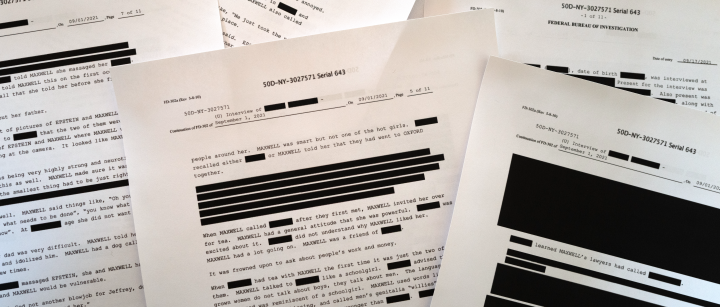
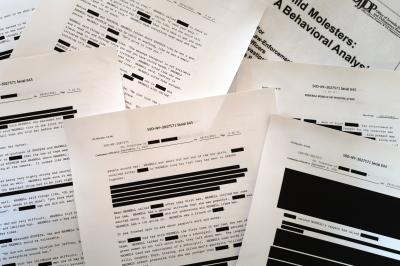 In this photo illustration, printouts from the Epstein files released by the Department of Justice are shown on Feb. 13 in Chicago, Illinois. Photo Illustration by Scott Olson/Getty Images.
On Sept. 10, Husted — and all but two Republican senators — voted to block a Democratic amendment to a defense budget and policy bill. The amendment, proposed by Senate Minority Leader Chuck Schumer, called for the attorney general to release all unclassified documents related to Epstein, including Department of Justice investigations of him and his associates, and information related to Epstein’s suicide.
In July 2019, federal authorities charged Epstein, a wealthy financier, with sex trafficking of minors, alleging that he “sexually exploited and abused dozens of underage girls by enticing them to engage in sex acts with him in exchange for money” between 2002 and 2005. A month after his arrest, Epstein died in prison. His death was ruled a suicide by the DOJ and the New York City medical examiner.
The Brown campaign has linked Husted’s September vote to a $3,500 contribution from Wexner two months earlier. “Just last year Husted took a maximum donation from Epstein’s co-conspirator and weeks later voted to block the release of the Epstein files. The record is clear,” Patrick Eisenhauer, Brown’s campaign manager, said in an email to us. (That is the maximum amount an individual can give to a candidate committee per election.)
At the time of the September vote, President Donald Trump was opposed to the DOJ releasing its files on Epstein. The two Republicans who voted in favor of releasing the files were Sens. Rand Paul and Josh Hawley.
Asked in a Feb. 18 deposition before a congressional committee whether he lobbied Husted or anyone else to block the release of the Epstein files, Wexner said, “Absolutely not.”
The Husted campaign noted that the September vote wasn’t on the standalone Epstein Files Transparency Act and said that it was “inappropriate” for Schumer to try to add the act as an amendment to the National Defense Authorization Act. “The NDAA is a bipartisan piece of legislation that covers military pay and benefits, and national security policy. Given that it is completely inappropriate and irresponsible to toy with military benefits and our country’s national defense, the Senate voted to table the amendment,” Amy Natoce, the campaign’s communications director, told us in an email.
Natoce contended that there was “a single recorded vote on releasing the Epstein files” — the Nov. 19 vote on the bill on its own. In a May 29 CNN interview, Brown argued this was “no real vote.” On Nov. 19, the bill passed by unanimous consent, meaning that no senator objected. Husted, therefore, along with the rest of the Senate, supported it.
The bill was signed into law the same day by Trump, who had changed his position and backed the legislation. The House had passed it by a 427-1 vote.
Donations to Husted
The Brown ad says that Husted “took more money from Jeffrey Epstein’s co-conspirators than anyone else in Washington,” and on screen, it says the contributions were 10 times more than what any other sitting senator got from “co-conspirators.” It doesn’t mention a specific dollar amount. The campaign sent us support for the ad, which details $116,892 in donations from 2001 to 2025 from Wexner.
That total includes $3,500 to Husted’s Senate campaign, $76,400 in donations for Husted’s state campaigns, and $36,992 that went to DeWine’s gubernatorial campaign when Husted was running on the ticket for lieutenant governor or to the DeWine-Husted transition fund.
The Brown campaign lists other “co-conspirators” or potential co-conspirators in FBI documents and then provides figures showing Husted’s total donations from Wexner are 10 times or more than what any other sitting senator received. For this article, we’re not delving into what other senators received. We’ll focus on the donations to Husted.
The Husted campaign hasn’t disputed the amount received from Wexner. And it’s not surprising that the Ohio-born billionaire would donate money to politicians in his state. Wexner is a well-known figure in the Buckeye State. His name graces three buildings on the campus of Ohio State University.
He also has made some sizeable contributions to Republicans. Wexner gave $250,000 in October to the National Republican Senatorial Committee, which works to elect Republicans to the Senate, according to Federal Election Commission data, and $250,000 in 2024 to a super PAC supporting Matt Dolan, who ran (and lost) in the Republican primary for Senate that year.
As for the “co-conspirator” label, it’s true that an August 2019 FBI email listed Wexner among eight Epstein “co-conspirators.” Wexner’s name was unredacted and made public in early February. The email listed him as a “secondary” co-conspirator and said that “[t]here is limited evidence regarding his involvement.” It also said that the U.S. Attorney’s Office for the Southern District of New York “is currently in contact with his attorneys and a subpoena has been served.”
Wexner’s attorney has said that he cooperated with the Justice Department and was told in 2019 by a federal prosecutor that he wasn’t considered a co-conspirator. He hasn’t been charged with any crime related to his relationship with Epstein, whom he had hired as a financial adviser decades ago.
About a week after Wexner’s inclusion in the August 2019 FBI document came to light, Husted, along with other Ohio lawmakers, said he would donate Wexner’s contributions to charity. The campaign told us he had donated $34,300 to Freedom a la Cart, a nonprofit that helps survivors of sex trafficking. “Those are all the funds that were available because the remainder were received in previous campaign cycles and spent during those cycles,” Natoce said.
In his prepared statement to the House Committee on Oversight and Government Reform on Feb. 18, Wexner said: “I was naïve, foolish, and gullible to put any trust in Jeffrey Epstein. He was a con man. And while I was conned, I have done nothing wrong and have nothing to hide.” He said he “never witnessed nor had any knowledge of Epstein’s criminal activity. I was never a participant nor co-conspirator in any of Epstein’s illegal activities.”
Wexner met Epstein in “the mid-to-late 1980s,” he said, and later hired him to manage his personal finances, giving Epstein power of attorney. Wexner claims that Epstein stole “vast sums” of money from his family but later returned a “substantial amount.” Around late 2007, Wexner said, he ended his association with Epstein, who was charged in Florida in 2006 with solicitation of prostitution. He pleaded guilty two years later to that charge and to solicitation of prostitution with a minor. “In light of his eventual guilty plea and deception of our family, we completely severed our relationship with Epstein,” Wexner said in his statement.
Donations to Brown
In pushing back on the Brown campaign’s criticism of the Wexner donations, the Husted campaign has cited contributions to Brown from what it calls “Epstein associates.” The Husted TV ad claims Brown “took a hundred grand” from these associates, citing on screen a March 7 New York Post article that puts the figure at “more than $124,000.” The article says that “Brown and Husted are far from the only politicians who took money from individuals with close ties to Epstein.”
A few of the people on the list the Husted campaign provided to us do have established, close ties to Epstein. But many don’t, and it’s unclear whether some on the list knew him.
The campaign cited 14 people who gave contributions to Brown, including Abigail Wexner, Les Wexner’s wife. She donated $10,200 to Brown’s campaigns from 2011 to 2017, and additional funds to his leadership political action committee from 2017 to 2019. The Husted campaign argues that this counts as also taking money from Les Wexner. “As a married couple, Abigail and Les Wexner share assets,” Natoce told us.
In a press release about the ad, Natoce said, “Brown is literally using Epstein money to run TV ads about Epstein money!”
None of the donors the Husted campaign identified has been charged with a crime related to Epstein, nor has any been identified as a co-conspirator. As we said, many have weak links to the late sex offender. For instance, one donor is mentioned in the Epstein files because Epstein asked an assistant for her email address. Another was invited to a dinner party Epstein was having and said he couldn’t attend. Another was among a list of names Epstein emailed to himself titled “billionaire.”
The campaign also flagged $20,400 in donations from billionaire philanthropist George Soros, citing a September 2019 FBI interview with a person who said he was a victim of Epstein and claimed Soros was present on a yacht with Epstein and several others and witnessed him being sexually abused. The FBI document said the alleged victim’s conversation with the FBI, which occurred after Epstein’s July 2019 arrest, “suggested some degree of possible mental illness or emotional instability.” The document also said this person wasn’t able to provide supporting evidence or “the identities of any witnesses to support his claim of victimization.”
Ghislaine Maxwell, who was convicted in 2021 for helping Epstein to recruit, groom and abuse minors, told the DOJ that she didn’t think Epstein knew Soros.
Some on the Husted campaign’s list either had a documented relationship with Epstein or what appear to be stronger links. Summers, the former Treasury secretary who resigned from his position at Harvard this year, had a friendship with Epstein, who hosted a 60th birthday dinner party for Summers in 2014. The released Epstein documents show Summers had dinner with Epstein in 2018, appeared to get romantic advice from Epstein that year and was corresponding with him in 2019. Epstein was arrested that July by federal law enforcement. Summers has called his relationship with Epstein a “major error in judgement.”
Summers gave $10,300 to Brown’s campaigns in 2024 and 2025.
Two others that the Husted campaign cited, including in the press release about the TV ad, are Casey Wasserman, an entertainment executive, and attorney Brad Karp, who donated $5,400 and $2,000 to Brown’s campaigns, respectively. Wasserman exchanged emails with Maxwell in 2003 in which he said he missed her and asked, “can we book that massage now?” He told the Hollywood Reporter early this year that he regretted the correspondence, which took place “long before her horrific crimes came to light,” adding that he “never had a personal or business relationship with Jeffrey Epstein.”
Karp sent an email to Epstein in 2015 thanking him for an invite to an event at Epstein’s home that Karp called “truly ‘once in a lifetime’ in every way.” Epstein responded that “there are many many nights of unique talents. you will be invited often.” The same year, Epstein asked Karp if it was possible to revoke a woman’s tourist visa, and Karp responded that he would work on it.
A 2003 email in the files said that media executive Barry Diller “would like to take a hike on the island” and indicated that Epstein had approved it. Diller — who donated $5,400 to Brown — said this year that “I am probably the only one who went to the island to see the architecture rather than the inhabitants.”
Husted’s camp also cited Reid Hoffman, who gave $7,000 to Brown’s campaign in 2025. Hoffman, co-founder of LinkedIn and a well-known Democratic donor, had meetings with Epstein as late as 2018. He said this year that he knew Epstein “because of a fundraising relationship with MIT, which I very much regret.”
In the Husted campaign press release, Husted accuses Brown of “hypocrisy,” saying, “Why won’t he donate the money he received from Epstein associates to charity?”
When asked by CNN about donating contributions from Abigail Wexner or Summers, Brown said that those donations are “not tied in any way the way the co-conspirator” donations are. He said it was “not real reporting to make those comparisons.”
Editor’s note: FactCheck.org does not accept advertising. We rely on grants and individual donations from people like you. Please consider a donation. Credit card donations may be made through our “Donate” page. If you prefer to give by check, send to: FactCheck.org, Annenberg Public Policy Center, P.O. Box 58100, Philadelphia, PA 19102.


