
Trump Makes Unsupported Claims About Drug Flows
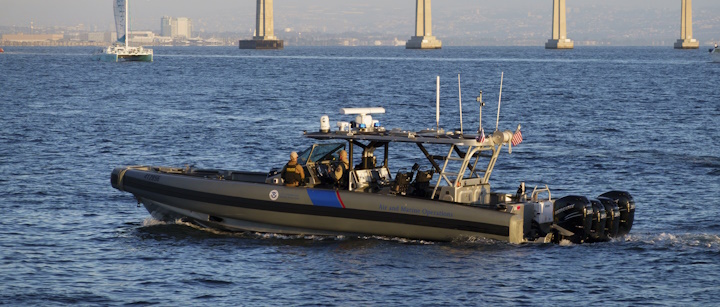
President Donald Trump has repeatedly said that his administration has “cut” by 97% “the flow” of illegal drugs entering the U.S. “by water, by ocean and sea.” But available federal data do not support that claim.
There is no comprehensive data on the total amount of drugs trafficked to the U.S., including how much authorities don’t capture. Without that information, drug policy experts have told us that it’s not possible to know if the president’s claim is accurate.
“[W]e do not know the true amount of drugs coming into the country because we don’t know the amount that comes in undetected (the known unknown),” Katharine Harris, a fellow in drug policy at Rice University’s Baker Institute for Public Policy, told us in an email.
She said the amount of drugs “seized” — which is what the federal government reports — is not equivalent to total drug “flow.”
However, Trump, based only on cherry-picked seizure data, continues to claim that his administration has almost completely stopped drugs from being brought into the U.S. by way of water.
“We cut the flow of fentanyl across our border by 59%, which is unheard of,” Trump said in May 22 remarks in New York. “And we cut the flow of fentanyl and drugs into our country by the ocean and the sea, in other words, coming in by water, by ocean and sea by 97%.”
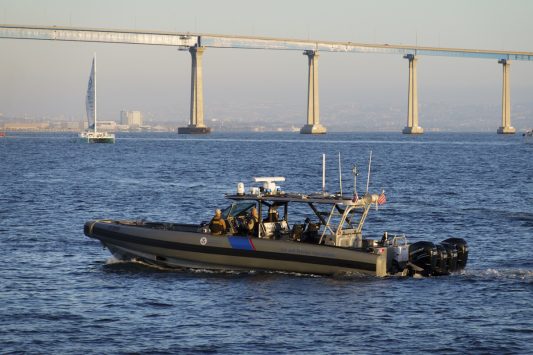 A U.S. Customs and Border Protection Air and Marine Operations boat patrols in San Diego Bay on July 29, 2025. Photo by Kevin Carter/Getty Images.
Then, on May 28, in an interview with his daughter-in-law, Lara Trump, on Fox News, he said, “We have drugs down 97%. Fentanyl and various drugs down 97% on drugs coming in by water.”
The president has made the 97% reduction claim more than a dozen times since late December.
We already addressed in February Trump’s unsupported claim that fentanyl coming across U.S. borders is down by more than half.
The amount of fentanyl seized by Customs and Border Protection decreased by about 50% in the first full 15 months of Trump’s second term, going from 26,398 pounds seized in President Joe Biden’s last full 15 months in office to 13,216 pounds seized in Trump’s first full 15 months, according to the most recent CBP data. Also, based on provisional data, the National Center for Health Statistics estimates about a 22% decline in overdose deaths from synthetic opioids, or fentanyl, between 2024 and 2025 — from 48,913 to 38,084.
The seizure data is often used as a proxy for how much enters the country undetected. To some, fewer pounds seized indicates that fewer drugs are being smuggled in — not more.
The fact that the seized amount has declined could mean that less of the drug is being trafficked into the U.S., but it could also mean that authorities are catching less of it. In October 2024, we wrote about then-Vice President Kamala Harris’ claim that the Biden administration had cut the flow of illegal fentanyl “by half” because the amount seized by border officials had increased in Biden’s first two years as president.
But experts said there was also insufficient data to support her statement.
“If you don’t know the denominator” – meaning the figure for the total flow of a drug to the U.S. – “you can’t have an answer,” David Luckey, director of the RAND Rural America Partnership Initiative and professor of policy analysis at the RAND School of Public Policy, told us for that 2024 story.
Trump’s claim about drugs coming by water is flawed for similar reasons.
When we asked for the source of his claim, a senior administration official sent only a hyperlink to the webpage with statistics on drugs seized by CBP’s Air and Marine Operations, which does aviation and maritime law enforcement.
Sometimes — such as in June 10 remarks in the Oval Office — Trump sounds as though he’s claiming that there has been a 97% cut in fentanyl coming by water. But that’s not really what he means.
Administration officials have told other fact-checkers that the president’s claim is based on the decrease in the amount of all drugs seized in July 2025 compared with November 2025.
There were 4,476 combined pounds of cocaine, fentanyl, marijuana, heroin and methamphetamine interdicted by CBP’s Air and Marine Operations last November, about a 98% drop from the 224,805 pounds seized four months earlier in July. But that particular comparison was cherry-picked.
That July, there was a huge one-month spike in the amount of drugs seized – mostly marijuana. The total weight seized had increased 1,140% from 18,132 pounds in June. Using July as a starting point made the change in drug seizures under Trump look like a much larger decline.
“Picking a different month” to start “would have shown a smaller decline,” Harris, of the Baker Institute, said of the White House’s calculation. She added, “Generally it’s more informative to look at these trends over at least a 12-month period, especially when the data are available, in order to account for things like seasonal variation and outlier events.”
In fact, as of April, the most recent data available, there had been 547,603 pounds seized by CBP’s Air and Marine Operations in Trump’s first full 15 months back in office. That was an increase of about 81% from the 302,548 pounds seized in the last full 15 months under Biden.
Even if the unusually large amount of drugs seized in July 2025 is excluded from that 15-month tally, the amount seized under Trump was still almost 7% higher than under Biden.
If an increase in seizures indicates more drugs getting into the country undetected – as some Republicans have said – that’s the opposite of what Trump has claimed is happening.
In addition, the U.S. Coast Guard says it — not CBP — is “the lead federal maritime law enforcement agency” responsible for water-based interdiction of illegal drugs.
In fiscal year 2025, which included about eight months under Trump, the Coast Guard said it seized a record of almost 510,000 pounds of cocaine in the Eastern Pacific Ocean and Caribbean – more than three times its annual average of 167,000 pounds.
In September, the last month of that fiscal year, the U.S. military began striking boats in the Caribbean Sea and Pacific Ocean that it claimed were bringing drugs to the U.S.
But the New York Times, citing epidemiologists, addiction scientists and public health experts, reported in May that cocaine is still widely available in the U.S., as drug smugglers have seemingly adjusted to the boat strikes by transporting their product in large shipping containers or using land routes through Central America.
Harris, the drug policy fellow, said the amount of drugs seized “can be paired with other data points, like the purity, price, and availability trends for a particular substance, to infer whether there has been a reduction in supply.” If drugs are more scarce, less potent and prices are higher, she said that could indicate a supply interruption.
“But the seizure data alone cannot substantiate claims about the true drug flow,” she said.
Editor’s note: FactCheck.org does not accept advertising. We rely on grants and individual donations from people like you. Please consider a donation. Credit card donations may be made through our “Donate” page. If you prefer to give by check, send to: FactCheck.org, Annenberg Public Policy Center, P.O. Box 58100, Philadelphia, PA 19102.


