
The Shaky Assumptions Behind Trump’s Over $500 Billion in Projected Drug Savings
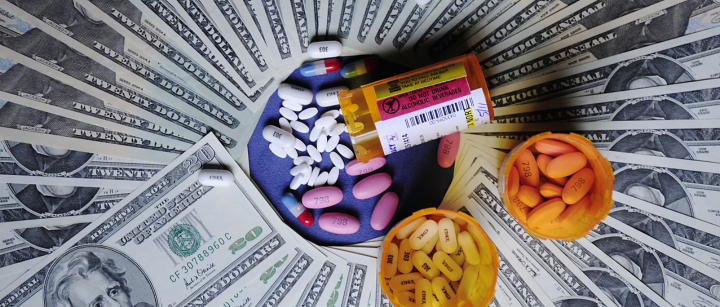
President Donald Trump has touted more than $500 billion in prescription drug savings over 10 years from his policies. But the savings are largely aspirational, and not based on the more limited actions the administration has taken so far.
The administration’s most favored nation policy seeks to bring down drug prices to levels paid in other countries. The bulk of the savings, estimated in a May 5 report by the White House Council of Economic Advisers, comes from assuming that all new drugs will be sold in the U.S. at MFN prices going forward, saving $529 billion. A smaller amount of savings, $64.3 billion, comes from applying MFN pricing to Medicaid.

“People are saving a lot of money,” Trump said at a May 18 event announcing the addition of more drugs to TrumpRx, the administration’s website directing people to cash prices for prescription drugs. “Over the next 10 years, the Council of Economic Advisers estimates that our most favored nation drug policies will save Americans over $500 billion. And this has been the greatest breakthrough in lowering healthcare costs in modern history.”
“Think about the $600 billion of savings to the average American over the next 10 years,” Dr. Mehmet Oz, administrator of the Centers for Medicare & Medicaid Services, said on June 2 at an event announcing further additions to the TrumpRx website, while calling on Congress to codify MFN pricing.
“It’s just a massive number that they voluntarily, sort of, gave back because the president went after them and said: ‘You got to deal with this problem,’” Oz continued, referring to the president’s negotiations with drug companies.
There isn’t evidence that drug companies have agreed to give back $600 billion in savings to Americans, much less savings that will go to “average” Americans. So far, the administration has made voluntary deals with 17 drug companies to lower drug prices. The White House and the companies have reported commitments to launch new drugs at MFN prices, as well as to offer MFN prices to states for Medicaid. However, the details of the deals have not been disclosed, and some companies have reported that they end after three years.
“Right now we just have a lot more questions than we have answers, and that makes it really difficult to assess the validity or accuracy or even ballpark-ness of this very large estimate of savings in the White House report,” Juliette Cubanski, vice president and director of the Program on Medicare Policy at the health policy organization KFF, told us. She added that it’s difficult even to evaluate the impact of the current voluntary deals given a lack of answers to key questions, such as “how many of these manufacturers’ drugs are subject to MFN pricing.”
When asked for more details on what has been done so far to achieve the savings in the report, White House spokesperson Kush Desai told us that “the research report lays out all of the assumptions underlying this analysis.” CMS did not respond to our request for comment.
The hundreds of billions in savings calculated in the CEA report do not come from offering people discounts on TrumpRx. As we’ve written previously, the prices on the site for brand-name drugs negotiated under the administration’s voluntary deals only represent savings for individuals in a few specific situations, such as when paying for fertility or weight loss drugs not covered by insurance, since many people will get better prices by using insurance rather than paying in cash. The CEA analysis only attempted to calculate 10-year savings from TrumpRx for Americans paying for fertility treatments, estimating these savings at $4.6 billion.
TrumpRx also recently started pointing people toward existing websites to access discounts on generic drugs. But as the CEA analysis itself acknowledged, generics are already cheaper in the U.S. than in other high-income countries, and they are not a target of MFN policies.
The U.S. does generally pay more for brand-name drugs than other nations. Prices in 2022 for these drugs were more than three times higher in the U.S. than in other high-income nations after adjusting for rebates, according to an analysis from the research organization RAND. But it is not clear how policies aiming to equalize drug prices will play out. As we have written previously, the president has repeatedly claimed broad victories over drug prices, even though they are hardly a done deal. There are significant uncertainties with his MFN approach, which still requires legislative action to further implement.
“We’ve seen no indication from pharma, from other key stakeholders, that this $600 billion number is real,” Jeromie Ballreich, an associate professor in the department of health policy and management at Johns Hopkins Bloomberg School of Public Health, told us, saying that one would expect companies to disclose to shareholders such an impact, which would be about 10% of U.S. pharmaceutical company revenue. “You would hear it outside of the White House, because $600 billion is, as Trump would say, huge.”
Missing Details From Trump’s Deals
Experts told us that it is difficult to evaluate the estimated nearly $600 billion in savings without more information on the president’s current or future MFN policies.
“This report is partly a report and mostly a press release,” Joseph Antos, a senior fellow emeritus at the conservative-leaning American Enterprise Institute, told us, adding that it is not possible to do an independent analysis based on the information provided.
Andrew Mulcahy, a senior health economist at RAND, told us that the hundreds of billions in savings are theoretically possible with a broad MFN policy but he said the administration’s actions so far only have “semblances” of accomplishing such a policy.
“Other countries’ prices are much lower than ours, and if policies are designed to piggyback on those prices, you can get savings in this order of magnitude,” he said. “That said, I don’t think that what’s happened so far — or plans for what will happen in the future — will align with that estimate in the CEA report for a variety of reasons.”
One key question is the length of the voluntary deals the administration has made with drug companies.
To get to nearly $600 billion in savings, the “key assumption” is that MFN pricing “will be implemented through legislation and affect all new product launches going forward,” Jens Grueger, a partner at Boston Consulting Group and affiliate professor at the University of Washington, told us in an email. The deals, however, appear to be limited to Trump’s time in office, he said.
Filings to the Securities and Exchange Commission from some of the companies have indicated the deals are limited overall, with two companies specifying they only last three years, STAT reported.
 Photo illustration by Karen Bleier/AFP via Getty Images.
“It’s very unclear how you can estimate savings over a 10-year period based on deals that we understand to be lasting only for three years, unless you assume that Congress will actually codify MFN pricing,” Cubanski said. Meanwhile, she added, many Republicans in Congress even oppose legislation that allows the government to negotiate drug prices, much less price-setting.
Rena Conti, a health economist at Boston University Questrom School of Business, told us that the assumption of MFN legislation was “hypothetical at best, as there is no movement in Congress to pass legislation.”
A second question is what exactly the companies agreed to in their commitments to price newly launched drugs at MFN prices. As we’ve said, the bulk of the savings — $529 billion — estimated in the report come from assuming new drugs will be broadly offered at MFN prices over 10 years.
While Trump has claimed his administration has achieved the lowest drug prices in the world, the CEA report explained that his administration’s MFN pricing policies ask that companies offer U.S. payers the second-lowest drug prices among those paid in a small collection of countries: the G-7 nations, plus Switzerland and Denmark. The approach uses net prices after adjusting for gross domestic product per capita in comparison to the U.S., the report said.
The CEA report estimated the 10-year savings from new drug launches at MFN prices by comparing historical prices in these countries between 2021 and 2025 and imagining that this MFN policy had been applied, the report explained. (The analysis omitted Denmark due to a lack of data.) The White House economists then extended their estimate to 10 years, assuming a 3% growth rate.
In coming up with the hundreds of billions of dollars in savings, the CEA report “essentially said it’s going to be the second-lowest price out of the reference basket,” said Ballreich, the pharmaceutical policy researcher from Johns Hopkins. “There’s a number of question marks about whether or not these drug companies that came and met with the White House and did this agreement actually agreed to this.”
Some of the White House announcements of the deals specify commitments companies have made to provide MFN prices on “all new innovative” or “all new” medicines. However, SEC filings have sometimes indicated limitations, saying that companies agreed to “price certain future medicines” at or below MFN levels or mentioning “certain exceptions” to promises to price new products at these levels.
Three companies recently declined to tell STAT whether three new drugs would be launched at MFN prices.
Questions About Medicaid Savings
There are similar questions about the $64.3 billion in estimated savings for Medicaid.
Press releases on the voluntary deals with drug companies indicate that the companies will provide MFN prices to state Medicaid programs for at least some drugs. CMS is launching GENEROUS, a voluntary Medicaid initiative running five years, and the companies that have signed deals are expected to participate for at least some of this time, according to a May 8 analysis from KFF. However, the KFF analysis said that it is unclear how many drugmakers and states will ultimately participate in GENEROUS and for how long, as well as which drugs will be included.
The prices states pay for Medicaid drugs are not publicly disclosed, but they are generally already the lowest in the U.S., researchers have previously told us, making it difficult to assess whether the MFN deals will be better than existing Medicaid prices.
“It feels very difficult to believe that companies are actually giving up a good chunk of revenue with these deals,” Mulcahy said. “What seems far more likely is that they are finding a way to formalize the discounts they are already offering” to Medicaid.
Ballreich said that in a study that has not yet been published, he and his colleagues had estimated savings in the first year of the GENEROUS program at “just about a third” of what the CEA report projected for that timeframe. His group’s estimate assumed complete participation in GENEROUS by drug companies and states but also attempted to take into account some mechanisms Medicaid already has to reduce drug prices.
Roadblocks to Achieving MFN Savings
Even assuming the Trump administration enacted policies to require all drug companies to offer MFN prices to all payers, it’s not clear how much money the U.S. would save. MFN policies could affect global drug prices in ways the report did not take into account.
Trump has suggested that companies would make up for losses in revenue in the U.S. by increasing prices in other countries. However, researchers expressed skepticism that other high-income countries would agree to significantly higher prices.
In addition, Antos of AEI pointed out that MFN policies could lead some drugs to never make it to market. “I don’t believe they try to take into account the effects of this process on future innovation,” he said, referring to the CEA estimate.
A June 10 release from the White House listing Trump’s “recent wins” said his MFN initiative was “projected to save Americans $500 billion over the next decade while protecting innovation and expanding access.”
Cubanski, however, said that if the report is correct, and prices fall some 30%, “we’d be looking at a pretty significant hit to revenues for pharmaceutical companies, and that could translate to somewhat less innovation, or maybe significantly less innovation.”
The estimate also doesn’t take into account how drugmakers and other countries might push back against the policies.
The CEA report “assumes that companies continue launching products in reference countries and that prices in these countries would converge towards US prices,” Grueger said. He suggested that this could happen for some products “that address a high unmet medical need and provide transformative benefits for patients.” Other countries consider benefits to patients relative to costs in determining what they will pay for drugs.
“However, for the majority of products this will be difficult to achieve, and companies might consider not launching these products outside the US to protect US prices,” Grueger said, citing recent statements from pharmaceutical executives suggesting such delays. “As a consequence, lower prices in reference countries would not be available and prices in the US would not drop as much as projected in the CEA report.”
“Not only would you potentially impede access to new medications in other countries, but we wouldn’t end up with lower prices here in the US either,” Cubanski said. She added that it is already typical for drugs to launch in the U.S. before they are in other countries, making it difficult to figure out how to set an MFN price for new drugs in the first place.
The researchers also questioned the administration’s ability to assess whether companies had fulfilled promises to offer drugs at MFN prices.
Companies provide list prices for drugs, but these are rarely paid. The CEA analysis said that drugmakers will report net prices, taking into account various forms of discounts. But experts said it was unclear how the government will independently evaluate these prices.
“The government obviously can try to compel [drug companies] to report this information, and there is some wording in there about auditing, but I don’t know how you audit something when you don’t have full disclosure or any basis for really determining in a systematic way whether numbers are correct or not,” Antos said.
Antos called it “telling” that the CEA analysis itself does not rely on net prices for its analysis. Rather, the report says, because of “the confidential nature of rebates, there are no existing data sets with net pricing information.”
Mulcahy explained that instead, the data the CEA used has gross prices a healthcare data company derives using complicated and varying methodologies in different countries. In general, he said, the numbers are based on invoices at various stages of the drug supply. He said that this dataset is the “best we’ve got” and is what he and his colleagues at RAND have used for international comparisons of drug prices, but it has limitations.
“If you can put whatever number down you want on an invoice and then negotiate something secret later, you can make it look like you’re saving a ton of money,” Mulcahy said, expressing concern that the MFN pricing deals would incentivize even more secrecy about international drug prices.
“I think there will be ways to hide discounts and backchannel funds for this,” Ballreich said, suggesting various ways drugmakers could give money back to payers outside the U.S. For example, they could institute rebates or taxes that are not drug-specific. He also said that drugmakers will be restricted from disclosing the true price of their drugs in other countries due to confidentiality agreements and laws in those countries.
“If you want to make a claim about how launch prices are going to change or if a company wants to promise to change launch prices … that’s easy to fudge,” Mulcahy said. “And then you find creative ways on the back end to make yourself whole again.”
“It’s kind of like everyone wins except for consumers,” he added.
Editor’s note: FactCheck.org does not accept advertising. We rely on grants and individual donations from people like you. Please consider a donation. Credit card donations may be made through our “Donate” page. If you prefer to give by check, send to: FactCheck.org, Annenberg Public Policy Center, P.O. Box 58100, Philadelphia, PA 19102.


