
Full-Time Employment Increased Under Biden, Contrary to Rick Scott’s Claim
Este artículo estará disponible en español en El Tiempo Latino.
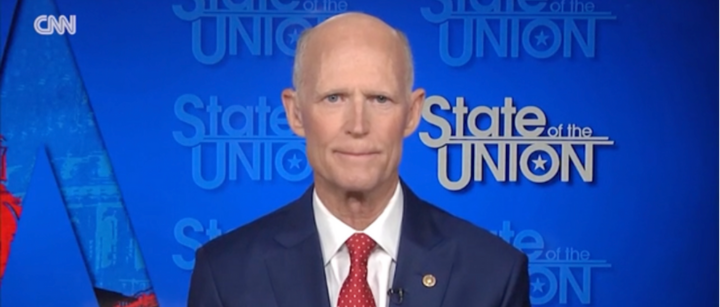
As we reported in January, President Donald Trump inherited a resilient economy experiencing continued growth in jobs, including an increase in full-time workers. But Republican Sen. Rick Scott recently painted a much different picture, calling the pre-Trump economy “crappy” and falsely claiming that full-time employment was “dropping almost the entire Biden administration.”
The U.S. senator from Florida made the claim during a March 9 interview on CNN’s “State of the Union.” After the show’s host, Jake Tapper, asked Scott about Trump’s recent admission that the president’s economic policies may cause “a little disturbance” for Americans, Scott began his response by first blaming former President Joe Biden.
“Well, first off, Donald Trump walked in with a crappy economy,” Scott said. “The number of full-time jobs has been dropping almost the entire Biden administration. This is a lot of work.”
We asked Scott’s Senate office for the source of his claim, but we did not receive a response.
He’s wrong about full-time employment, according to Bureau of Labor Statistics data.
When Biden left office in January, the number of people usually working full time — meaning 35 hours or more a week — was almost 135.9 million. That was up 8.5% from about 125.2 million full-time workers when Biden became president in January 2021, during the economic recovery from the COVID-19 pandemic that began in March 2020. In February, that figure dropped to about 134.7 million.
Notably, the January 2025 total is higher than the February 2020 pre-pandemic level of almost 130.9 million usual full-time employees. (The monthly job figures come from a survey based on the pay period that includes the 12th of the month.)
If Scott was thinking of monthly job losses, there were 17 months under Biden in which the number of full-time workers declined on a month-to-month basis. But full-time employment grew the other 31 months of Biden’s term, resulting in a net increase.
For additional context, the share of workers usually working full time was 80.7% in 2023, the most recent annual BLS data available. In 2022, it was 81.9%; in 2021, Biden’s first year in office, it was 81.8%; in 2020, the first year of the pandemic, it was 80.9%; and in 2019, prior to the pandemic, it was 80.8%.
As for Scott’s claim that Trump took over a “crappy economy,” that is part of a GOP narrative suggesting that Trump has to repair an economy in poor condition.
In a March 11 House Republicans’ press briefing that touched on Trump’s tariff policies, Speaker Mike Johnson said that Trump has “to reshape and shape things because it’s in a real mess” after “four years” of “a disaster in economic policy and every other measurement of public policy.”
During his March 4 address to Congress, Trump made the exaggerated claim that he “inherited, from the last administration, an economic catastrophe.”
To be sure, the state of the economy wasn’t perfect when Trump began his second term. But it wasn’t “crappy” or a “catastrophe,” either. In our January article “What Trump Inherits, Part 2,” we mentioned a number of economic indicators that could be interpreted as positive.
We reported that Trump was reclaiming “a resilient economy that has grown by at least 2.5% every year since he left office in early 2021”; “a post-pandemic jobs boom that has driven the unemployment rate well below the historical norm”; “inflation that has come down significantly in the past two years, but has been creeping up as of late”; and “a stock market that has made huge gains since he was last president.”
In a March 12 interview with NewsNation, Maryland University professor and economist Peter Morici also noted that “inflation has come down quite a bit” — from 9.1% in the 12-month period ending in June 2022 to 2.8% in February — and “the economy was growing well” under Biden.
And back in December, IBM Vice Chair Gary Cohn, who was the director of the White House National Economic Council during Trump’s first term, said in an interview on CBS’ “Face the Nation” that Trump was inheriting a “very stable economy” with “real solid economic growth,” “real job growth” and “real wage growth.”
“This notion that he inherited a bad economy is just silly,” Morici said, referring to Trump.
Editor’s note: FactCheck.org does not accept advertising. We rely on grants and individual donations from people like you. Please consider a donation. Credit card donations may be made through our “Donate” page. If you prefer to give by check, send to: FactCheck.org, Annenberg Public Policy Center, P.O. Box 58100, Philadelphia, PA 19102.


