
Trump Fumbles the Facts with Farmers
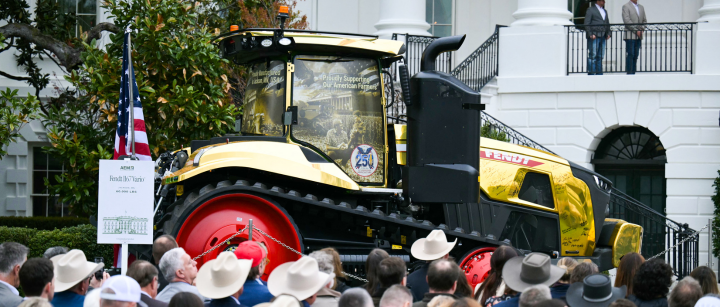
In a speech to what he called “the single largest gathering of American farmers that the White House has … ever had,” President Donald Trump distorted the facts on the estate tax, soybean exports and more.
- Trump falsely claimed that “we saved 2 million American farms from extinction by virtually ending the unfair estate tax.” That’s roughly the total number of farms in the country. The U.S. Department of Agriculture said only about 1% of farms would have paid any estate tax even if Congress had not permanently extended provisions that were set to expire. Experts say few, if any, farms were saved from extinction.
- He wrongly claimed that “American soybeans are now being shipped to China in record amounts.” U.S. exports aren’t on track for a record this year, and a trade deal the administration announced last year doesn’t show record amounts, either.
- The president said that beef prices were “starting to come down,” but price data show little to no indication of that.
- He said “the number of cattle was way down” due to an environmental restriction that he “got rid of.” But the White House pointed to the Green New Deal, a nonbinding resolution that never passed.
- Trump said that $12 billion in aid provided to farmers was paid from increased tariff revenue, but the money came from the Commodity Credit Corporation, which gets regular appropriations from Congress.
The president spoke to farmers gathered on the South Lawn of the White House on March 27.
Farms and the Estate Tax
Trump falsely claimed that “we saved 2 million American farms from extinction by virtually ending the unfair estate tax.” There aren’t even quite 2 million farms in the U.S., and tax experts say the number of small farms that got estate tax relief from the One Big Beautiful Bill Act championed by Trump was vanishingly small.
Here’s what Trump said in his address to farmers:
Trump, March 27: Very importantly, we saved 2 million American farms from extinction by virtually ending the unfair estate tax. We’ve ended the estate tax, or as they call it, the death tax, and you can now keep your family farms in the family. … No, it was a big thing. I would see farmers and they pass away … and the children would get hit with this massive tax bill for the value of the farm. Sometimes the farm is very valuable, but the cash isn’t so readily available. And they go out to a bank and they’d borrow money and they’d borrow and borrow and borrow to pay the tax. They’d be working for 20 years to pay it off. If they had a bad season, they’d lose their farm. … And you’d have, actually, many, many suicides over it. They would actually commit suicide because they couldn’t stand the concept of losing their family farm.
Trump did not end the estate tax, which is a tax on inherited assets over a certain amount. The Tax Cuts and Jobs Act, which Trump signed into law in 2017, doubled the assets threshold that would trigger an estate tax. That decreased, but did not entirely eliminate, the number of people subject to the estate tax. That provision was scheduled to expire at the end of 2025, but the One Big Beautiful Bill Act, which Trump signed into law in July 2025, permanently extended the more generous exemptions for the estate tax. For 2026, the thresholds triggering the estate tax are $15 million for individuals and $30 million for married couples.
But more importantly, only a small fraction of farms pays any estate tax.
To back up Trump’s claim, a White House official pointed us to an April 2025 article from the American Farm Bureau Federation, an advocate for farmers, that stated, “The estate tax, also called the ‘death’ tax, turns a time of mourning into a race against time to pay a government bill. Exactly nine months after the death of a family leader, some farm families owe the Internal Revenue Service (IRS) up to 40% of their farm’s value above an exemption limit. Without an act of Congress this year, the estate tax exemption will drop by 50% to $7.61 million on Jan. 1, 2026, putting the future of thousands of farm families at risk.”
The article noted that in 2024, the USDA “estimated that if the estate tax exemption reverts to its pre-TCJA level, nearly twice as many farms in every sales class would have to pay estate taxes.”
That’s true, but according to that USDA estimate, “the share of farm estates estimated to owe Federal estate tax would increase from 0.3 to 1.0 percent.”
“The story he [Trump] tells is dramatic but almost entirely untrue,” Howard Gleckman, a visiting fellow at the Urban-Brookings Tax Policy Center, told us via email.
Although the Tax Policy Center has not modeled the estate tax impact on farms recently, Gleckman noted that “we estimated that a total of 3,960 decedents paid the estate tax in 2023. Those were total deaths, including all occupations. Since the vast majority of family farms are worth much less than $15m/$30m, the impact on farms is vanishingly low, and TPC concludes that zero small family farmers paid the tax.”
“It also is worth noting that any business owner subject to the estate tax has many tools to avoid the tax,” Gleckman said. “For example, they can create trusts or buy life insurance, which effectively pays the tax.”
In an article published in the Iowa Law Review in May 2025, Kathleen DeLaney Thomas, a professor at the University of North Carolina Law School, explored what she called the “myth” of “the threat of taxing family farms out of existence.”
“In the minds of voters, the family farmer is a sympathetic taxpayer who is cash poor but holds valuable property,” Thomas wrote. “Federal taxes that are based upon property values (like a wealth tax or an estate tax), rather than on cash income, appear to pose a risk that the family farm would have to be sold to fund such a tax. Yet, there is no empirical evidence that any family farm has ever been sold in the United States to fund federal taxes.”
As an aside, we weren’t able to find any examples of American farmers who committed suicide because of the prospect of losing their farm due to the estate tax, let alone “many,” as Trump claimed. There was a widely reported case of a man who committed suicide in 2025 due to worry about inheritance tax changes, but that was in the United Kingdom.
Soybeans to China
Trump falsely said that “American soybeans are now being shipped to China in record amounts,” touting a figure that he said he negotiated with China’s president. But U.S. exports are not on track this year to reach a record. A trade deal the White House announced in November also doesn’t show an agreement for record exports.
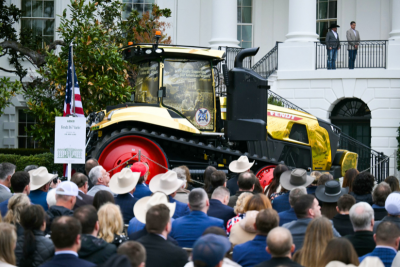 Farmers attending Trump’s March 27 speech at the White House. Photo by Oliver Contreras / AFP via Getty Images.
“Thanks to our trade deals, you’re now sending over $40 billion in American soybeans to China,” the president said. “I want to thank President Xi of China, because we had a deal at 20, and I said, ‘Could you do me a favor? It’s a big place, could you double it?’ … He said, ‘All right, I’ll do it,’ and you got 40 instead of 20.” Trump went on to make his claim about “record amounts” of soybeans now going to China.
Data from the USDA show that soybean exports to China, as of March 19, are about half the amount they were last year. “We’re not looking at record export sales, at least so far this year,” Chad E. Hart, a professor, extension economist and crop markets specialist at Iowa State University, told us.
Mindy L. Mallory, an associate professor of agricultural economics at Purdue University, similarly said that “we are not even close to normal buying, let alone record buying.”
U.S. soybean exports to China totaled 11.2 million metric tons for the marketing year as of March 19, according to the USDA data. That’s about half the amount exported to China over the same period the year before, which was 21.8 million metric tons. (The marketing year is Sept. 1 to Aug. 31, covering the harvesting of the crop and what happens to it before the subsequent harvest, Hart explained. So, last year would be Sept. 1, 2024, to Aug. 31, 2025, and the current marketing year started Sept. 1, 2025.)
Typically, just over half of U.S. soybean exports go to China, Mallory told us. But exports dropped considerably in 2025, due to Trump’s policy of increasing tariffs on U.S. imports from China and China’s subsequent retaliatory policies for goods it gets from the U.S. For several months, China didn’t import any U.S. soybeans.
In early November, the White House announced that Trump and Xi had made a deal on trade. A Nov. 1 White House fact sheet said: “China will purchase at least 12 million metric tons (MMT) of U.S. soybeans during the last two months of 2025 and also purchase at least 25 MMT of U.S. soybeans in each of 2026, 2027, and 2028.”
Those amounts wouldn’t be records, either. Mallory said 25 million metric tons for a year would be “just below the average of the prior six years.”
In a Nov. 17 paper published on farmdoc daily, a website run by the University of Illinois at Urbana-Champaign, other Purdue agriculture economists wrote, “If China purchases at least 25 million tons of U.S. soybeans in each of 2026, 2027, and 2028, that volume would still be 14% lower than the five-year average of 29 million tons of soybean shipments to China from 2020 to 2024. The ten-year average was 27 million tons.” A chart in that paper shows that, over the previous 10 years, annual exports to China only dipped below 25 million metric tons in 2019 (22.6 MMT) and 2018 (8.2 MMT), during another trade disagreement in Trump’s first term.
It’s unclear if Trump is suggesting that he had secured a commitment from Xi for a larger amount of exports than the White House announced. The White House didn’t respond to our request for clarification of how much China had agreed to and when it would import $40 billion of soybeans, as Trump said. When we asked about the president’s claim, a White House official said: “China has agreed to increase its purchases of U.S. soybeans by millions of metric tons, in addition to increasing purchases of other commodities.”
For the marketing year, Hart said, exports to China are typically in the range of $16 billion to $20 billion, depending on prices. He said the president’s $40 billion figure must be a cumulative figure for multiple years, noting that the U.S. announcement concerned export amounts for several years.
Beef Prices
Trump said that the price of beef “is starting to come down.” But there’s little to no indication of that. He went on to falsely claim that “the number of cattle was way down” due to an environmental regulation concerning “gas permeating throughout the air,” adding that “we got rid of that one, too.” A White House official said he was referring to the Green New Deal, a nonbinding congressional resolution that didn’t pass.
We’ll start with beef prices. They have been high, due to several factors, which we’ll explain. The price of a pound of ground beef was an average $6.74 in February, according to Bureau of Labor Statistics data. That’s down a mere penny from January, and it’s up $1.19 since January 2025. The price had gone up 52 cents from January 2024 to January 2025.
Uncooked beef steaks cost $12.74 per pound in February on average. That’s up 44 cents from January and up $1.83 from January 2025. Uncooked beef roasts were $8.93 per pound on average last month, down from a high of $9.29 in November. But the latest figure is still $1.21 more than the average price in January 2025.
Beef prices “are far from coming down,” Bob Chudy, a consultant for the beef industry, told us in an email. Chudy pointed to USDA figures for choice cutout, which he called “the best measure of wholesale beef prices.” Using a monthly average of weekly prices the USDA provides, Chudy said that choice cutout “jumped from an average of $3.69/lb in February to $3.94/lb in March.” That’s an increase of 25 cents. “And we are going into a period of seasonally stronger demand, with spring and summer grilling season around the corner.”
Chudy said that “beef supplies are historically low. There is nothing this administration can do to reduce beef prices for the balance of 2026 and extending into 2027 and likely 2028. Any short term deviations to the contrary are just that.”
As we’ve explained before, drought conditions in the U.S. over the past few years affected the feed for cattle and led to a slow reduction in the cattle herd, Bernt Nelson, an agricultural economist at the American Farm Bureau Federation, told NBC News last summer. In a February Farm Bureau report drawing on USDA data, Nelson said the U.S. cattle inventory on Jan. 1 was 0.3% lower than in 2025, beginning the eighth year of contraction and “with little opportunity for meaningful expansion until at least 2028.”
“Tighter cattle supplies will contribute to higher prices and volatility for cattle and beef in 2026,” Nelson wrote.
Also, last year, the USDA suspended imports of live cattle from Mexico because of cases of New World screwworm, a parasite that kills host animals. Chudy called that “a huge factor” that “has choked off a valuable supply of animals raised in USA feedlots.”
And there are also demand issues. Altin Kalo, head economist with the Steiner Consulting Group, which focuses on the food industry, told us, “Beef demand has been exceptional in recent years and has been a big contributor to the rise in beef prices in recent years. Indexes that ag economists use to track the shift in demand over time show that in 2025 demand was up 8% vs. previous year and near 27% from pre-COVID levels.” Kalo cited several factors for the increase in demand, including income and employment, high quality of beef products and a shift to higher-protein diets, and consumers eating more meals in restaurants than in the past.
In November, Trump scrapped 50% tariffs he had placed on Brazilian imports, including beef.
Green New Deal
After mentioning prices, Trump made his claim about environmental concerns reducing the number of cattle.
Trump: Beef was, it was an amazing thing, I was told by [Agriculture Secretary] Brooke [Rollins]. I said, I don’t really believe it. They wanted to have less cattle in the country for environmental reasons. … These are sick people. No, they want less cattle for environmental reasons. It has something to do with gas permeating throughout the air. And we actually — and that’s what happened. And these, the number of cattle was way down. I said, what happened? They were mandated. They were restricted for that reason. These people are crazy. But anyway, we — we got rid of that one too. That was an easy one.
When we asked what environmental regulation Trump was referring to, a White House official told us: “President Trump is including the insane Green New Scam provision that sought to limit cow herds in order to reduce methane emissions,” linking to a 2019 New York Post article about the Green New Deal resolution, which was introduced by Democratic Rep. Alexandria Ocasio-Cortez that year.
That resolution, which was nonbinding, never passed. The number of cattle wasn’t “mandated” or “restricted” under the resolution, so there was nothing for Trump to get rid of, either.
The president has made a similar claim about the Green New Deal before, falsely saying in 2019 that it would “eliminate” all cows. Ocasio-Cortez did express concern about greenhouse gas emissions from cows, as have other environmentalists. (Methane emissions from agricultural livestock contribute to greenhouse gas emissions, as the Environmental Protection Agency says.) But as a nonbinding resolution, the Green New Deal was a broad vision for addressing climate change. If it had passed in Congress — which it didn’t then, nor when introduced in later years — lawmakers would have needed to propose separate legislation on steps to take to reach the resolution’s goals for emissions.
As we explained in 2019, the resolution doesn’t say anything about limiting cows. But two FAQ documents from the resolution’s supporters mentioned cows, garnering a lot of attention at the time. A fact sheet said: “We set a goal to get to net-zero, rather than zero emissions, in 10 years because we aren’t sure that we’ll be able to fully get rid of farting cows and airplanes that fast.” A blog post on Ocasio-Cortez’s website expressed a similar idea.
Farm Aid Not From Tariffs
Trump again claimed that $12 billion in aid provided to farmers was paid from increased tariff revenue, but the funding came from regular appropriations.
Trump said: “To further help farmers recovering from the Biden catastrophe, we use money taken from tariffs, the tariffs — we’ve taken in hundreds of billions of dollars from the tariffs, and as I said, we gave you $12 billion in farm relief. And that happened just recently because you were hurt by certain countries unfairly. And I said you were unfairly hurt and we gave you $12 billion and that — that made up for it.”
The $12 billion bailout for American farmers came soon after China slashed its purchase of American soybeans in 2025 following Trump’s imposition of additional tariffs on imports from China.
“The Soybean Farmers of our Country are being hurt because China is, for ‘negotiating’ reasons only, not buying. We’ve made so much money on Tariffs, that we are going to take a small portion of that money, and help our Farmers,” Trump posted on Truth Social on Oct. 1.
But as we have written, the $12 billion was paid for by the Commodity Credit Corporation, a government-owned corporation that provides funding for agricultural programs and gets regular appropriations from Congress, according to a press release from the USDA.
Editor’s note: FactCheck.org does not accept advertising. We rely on grants and individual donations from people like you. Please consider a donation. Credit card donations may be made through our “Donate” page. If you prefer to give by check, send to: FactCheck.org, Annenberg Public Policy Center, P.O. Box 58100, Philadelphia, PA 19102.


