
$1.8 billion ‘anti-weaponization’ fund lacks legal precedent
The Trump administration said it is settling a presidential lawsuit over leaked tax data by establishing a $1.776 billion fund to pay people who say they were victims of judicial “weaponization” under President Joe Biden.
Democratic critics reacted swiftly.
Rep. Seth Moulton, D-Mass., called the fund “blatant corruption” and a “cash grab.” Sen. Elizabeth Warren, D-Mass., said it is “an insane level of corruption — even for Trump.” Sen. Ron Wyden, D-Ore., posted on X, “If Trump follows through, it will be the most brazen theft of taxpayer dollars by any president in history.”
Democrats said the money might be used to pay people who rioted at the U.S. Capitol on Jan. 6, 2021, all of whom President Donald Trump pardoned as one of the first acts of his second term.
Trump administration officials did not rule that out.
Acting Attorney General Todd Blanche told lawmakers May 19 he could not promise to bar compensation for Jan. 6, 2021, rioters, Trump campaign donors or Republican lawmakers whose phone records were seized by then-Special Counsel Jack Smith, who investigated Trump between his two presidential terms.
Trump weighed in May 18: “This is reimbursing people that were horribly treated, horribly treated. It’s anti-weaponization. They’ve been weaponized. They’ve been, in some cases, imprisoned wrongly. They paid legal fees that they didn’t have. They’ve gone bankrupt. Their lives have been destroyed.”
He continued, “There’s been numerous other occasions over the years where things like this have been done.”
The federal government often reaches settlements with plaintiffs, and occasionally with large classes of people. Under law, an existing federal judgment fund can be used to pay billions of dollars annually in settlements for “actual or imminent litigation against the government” or settlements by agencies at the administrative level, not involving a lawsuit.
But the Justice Department, in announcing the new settlement fund, pointed to one particular case.
In a May 18 press release, the Justice Department cited a 2011 settlement for the case Keepseagle v. Vilsack as “legal precedent” for the new fund. That case involved lawsuits by Native American farmers who alleged discrimination in federal assistance by government agencies.
We found broad consensus among legal experts that the new fund differs from the Keepseagle fund in four important ways.
“Never in the history of the republic has an acting president leveraged his private litigation, against his own administration no less, to develop what, in effect, is a public benefit program tailor-made for his political supporters and allies,” said Adam Zimmerman, a University of Southern California law professor who is an expert on presidential settlements.
Police officers who served at the Capitol on Jan. 6, 2021, filed suit May 20 to block the new settlement fund.
When contacted for comment, the White House referred PolitiFact to the Justice Department, which did not respond to our inquiry.
Differing standards for qualifying for compensation
The Keepseagle settlement established specific requirements for people to receive payouts from the fund. Recipients had to be Native American and have farmed or ranched, or attempted to farm or ranch, from 1981 to1999. They had to have sought a loan or loan servicing from the U.S. Agriculture Department during that period. And they had to have filed a complaint at the time they were denied a loan or otherwise treated unfavorably.
By comparison, the standard for compensation from the new fund is vague. The document establishing the fund says potential recipients must “assert at least one legal claim stating that the claimant was a victim of lawfare and/or weaponization.” It does not define the terms “lawfare” or “weaponization.”
Gregory Sisk, a University of St. Thomas law professor, called these parameters an “amorphous plan” to pay unidentified people.
The judicial branch’s role
A federal judge approved the Keepseagle settlement, and it had to meet ongoing judicial approval. An appeals court upheld the agreement; the Supreme Court declined to hear an appeal.
Experts said the Keepseagle settlement’s distribution of excess funds to nonprofit organizations serving Native American farmers and ranchers was unusual, but the 2011 settlement that received judicial approval included that possibility.
In his May 19 congressional testimony, Blanche said five appointees who will oversee the new fund will act independently. But the fund description included no judicial role at any stage. Once Trump’s lawyers dropped their IRS leak lawsuit, any possibility for judicial oversight vanished.
The five-member panel appointed by the attorney general will decide on payouts, with one of the members chosen “in consultation with congressional leadership.” The president “can remove any member without cause,” the fund outline says, and the president also can fire the attorney general at will, as Trump has already done in his second term.
Such a structure, Sisk said, creates a high risk “that it will be paid to allies of the Trump administration as an ongoing political fund.”
The size of the new fund is much bigger than Keepseagle’s
The Keepseagle settlement had a $760 million value. Of that, $380 million was left undisbursed to individuals and went to nonprofits. In today’s dollars, the $760 million would be $1.15 billion. The settlement considered 4,300 claims, of which more than 3,600 were accepted.
The new $1.776 billion fund is larger, and the group of potential recipients might be smaller.
The new fund is more than twice as large as Keepseagle’s fund in nominal dollars, and 50% larger in inflation-adjusted dollars. The number of pardoned Jan. 6, 2021, rioters is around 1,600. Even if they’re all included, plus additional claimants in unrelated cases, the total would still likely be smaller than the number of Keepseagle beneficiaries.
“This is a huge payout for a claim by a small number of individuals,” Sisk said.
The funds were created through different processes
The Keepseagle settlement fund and the lawsuit that prompted it addressed the same issue. The people who could claim compensation from the Keepseagle fund were plaintiffs in the original lawsuit, which is standard for how such settlements are created, said Tax Law Center Policy Director Brandon DeBot.
The new settlement fund, however, did not involve a class of plaintiffs, and the suit that led to the new settlement involved leaks of Trump family tax documents. “The fund, and the issues it purports to redress, have nothing to do with the originating lawsuit and leaked information at the IRS,” said Cheryl Bader, a Fordham University law professor.
The plaintiffs in the IRS leak case “were the president, his family, and one of their businesses,” DeBot said, and they are specifically barred from receiving monetary payment or damages from the fund.
Our ruling
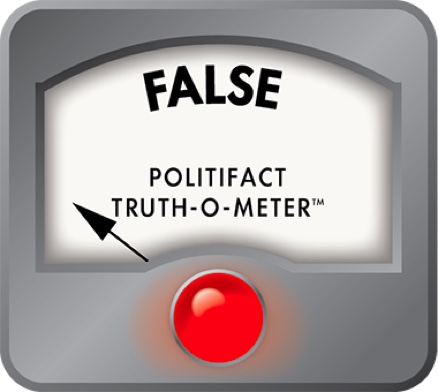
Trump said, “There’s been numerous other occasions over the years” when the federal government created a reserve similar to a new, $1.776 billion anti-weaponization settlement fund.
The Justice Department cited a single settlement in a lawsuit filed by Native American farmers as legal precedent for the new fund, but the two differ in at least four fundamental ways.
The earlier case had more specific compensation standards; significant judicial oversight; a smaller dollar amount for a potentially bigger group of beneficiaries; and a more standard process for creating it.
We rate the statement False.


