
America’s 250th anniversary compared with its 200th
A country in a sour mood. Inflation and gasoline prices soaring. A culture war raging. A president with sagging approval ratings.
America at 250? Actually, America at 200 and 250.
As the United States celebrates the 250th anniversary of its founding, a look back five decades to 1976 — the year of the nation’s bicentennial — reveals notable similarities with today.
Substitute Richard Nixon for Donald Trump, Vietnam for Iran and Watergate for using the Justice Department to reward friends and punish enemies and you can see a pretty fair resemblance between 1976 and 2026.
“The parallels are eerie: international conflict, domestic strife, political turmoil, partisan division and economic instability,” said Marc Stein, a San Francisco State University historian.
As the 250th approached, we asked a handful of historians to describe their sense of the national mood during both celebrations, and how the commemorations were similar and different.
In both 1976 and 2026, the U.S. was celebrating an anniversary amid “major crises of confidence about national values, vices, and virtues, and about the past, present, and future of national greatness,” Stein said.
The zeitgeist during the two periods diverged in some ways, notably in the degree of partisan polarization, which is generally considered much higher today.
How did the nation celebrate the bicentennial?
In recent weeks, several musical acts pulled out of a series of 250th anniversary concerts scheduled on the National Mall. The performers’ complaint that the event had become politicized was underscored when Trump countered by saying he might hold a political rally instead.
Other 250th anniversary events, many organized by the Freedom 250 group with close ties to Trump, include a UFC event on the White House lawn and a religious event on the National Mall.
A top-down presidential approach is not entirely new for such celebrations; it’s also how the bicentennial developed.
Planning began a decade ahead of time in 1966, with President Lyndon B. Johnson creating a bipartisan commission to organize the commemoration. Johnson wanted a World’s Fair, an echo of the 1876 centennial in Philadelphia. But within two years, Johnson was out of office.
When Nixon became president, he appointed “political cronies and longtime supporters” to the commission, wrote M.J. Rymsza-Pawlowska, an American University historian and author, in an essay on the bicentennial.
Before long, she wrote, critics said Nixon was framing the bicentennial in ways that centered himself and his 1972 campaign. Some said the committee was “corrupt and unwieldy.” Others, including the Black Panther Party and the American Indian Movement, said the effort was paying scant attention to the history of racial and ethnic minorities. Alternative bicentennial organizing committees emerged.
Eventually, the Nixon administration responded to the criticism by shifting gears, initiating a more hands-off process of handing out money to local groups without strict federal mandates. The idea was to empower local communities to undertake historical projects meaningful to their own communities.
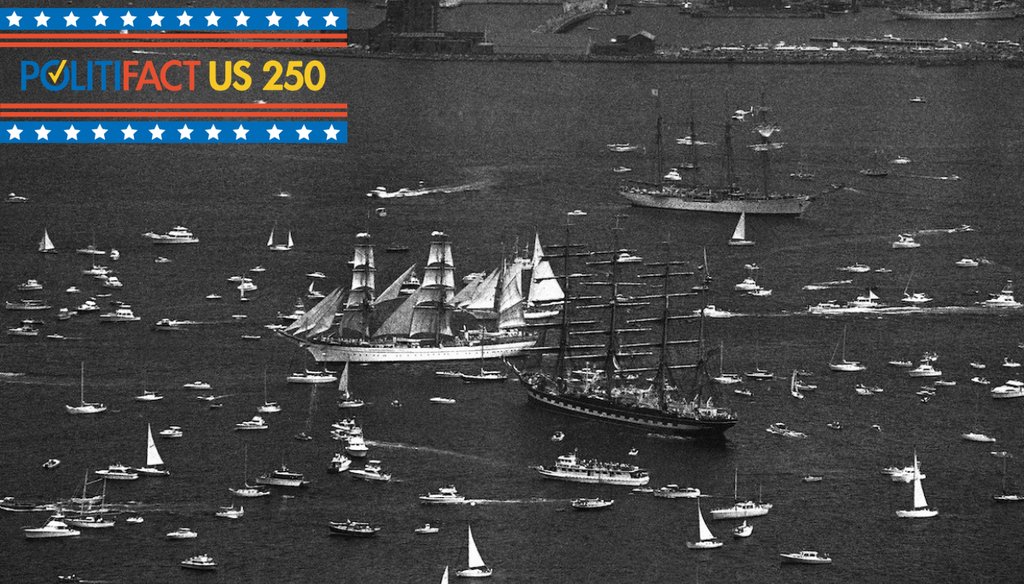
While some activities were national in scope — including a parade of tall ships, a reverse wagon train from west to east and a July 4 fireworks show — the majority were hyperlocal. They ranged from the restoration of a railroad station in Ogden, Utah, to preservation of a historic one-room schoolhouse at Bowling Green State University in Ohio and a Seafood Heritage Trail in Biloxi, Mississippi.
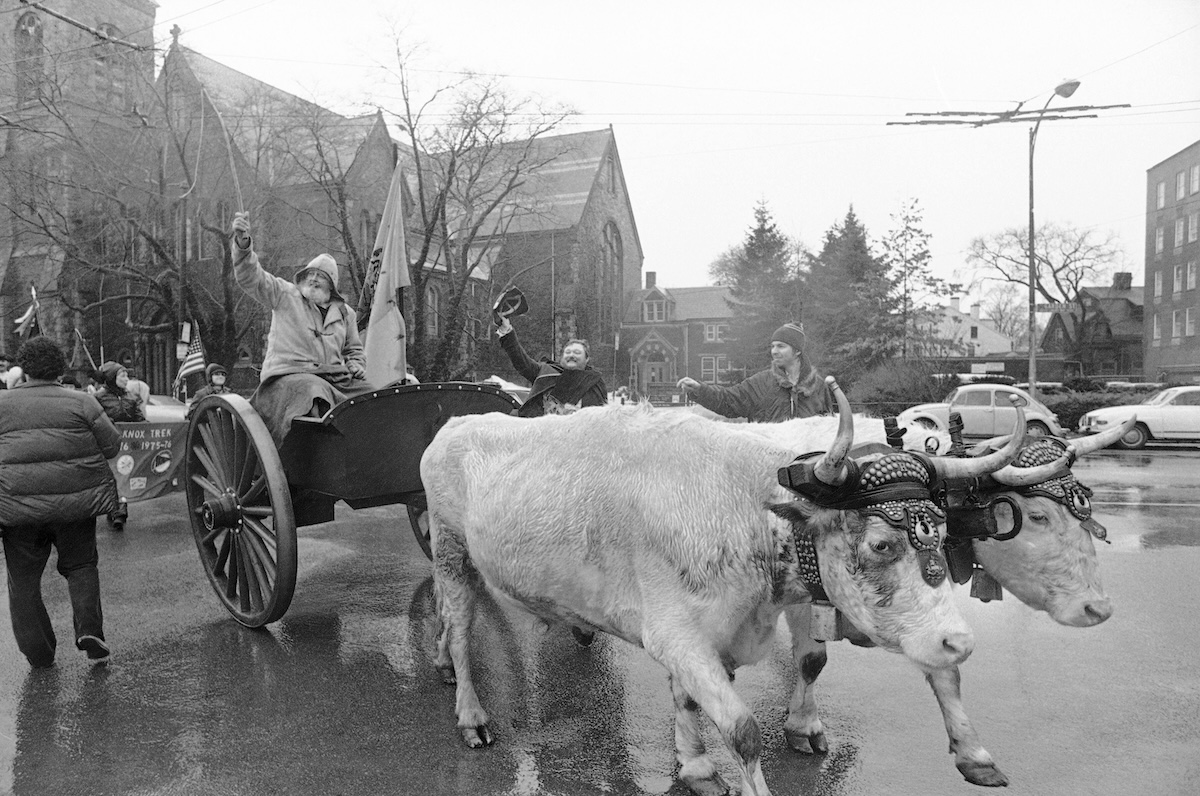
A team of oxen hauls cannon into Cambridge, Massachusetts, in a re-enactment of a march 200 years earlier from Fort Ticonderoga, New York, on Jan. 28, 1976. (AP)
A study by the General Accounting Office, the former name of Congress’ investigative arm, found “1,766 historical re-enactments, beauty pageants, tree plantings and an “oldtime fiddlers’ contest,” David Skinner, a former editor at the National Endowment for the Humanities, wrote recently for The Wall Street Journal. In contrast to today, bicentennial imagery was everywhere, including the most unexpected places; several archival collections attest to the wide variety of consumer items stamped with bicentennial themes, from popcorn buckets to dry cleaner hangers and diaper bags.
The mood of historical discovery was evident in a range of activities and offerings, from research into family ancestry to television blockbusters like the slavery saga “Roots.”
Rymsza-Pawlowska told PolitiFact that the way the bicentennial celebration developed — more pluribus than unum — fit the nation’s mood. Beginning in the 1960s, “an entire generation of people became interested in their communities and in self-determination, and that’s the way the celebration ended up.”
Particularly after Nixon resigned in 1974 and Gerald Ford succeeded him, the presidential role became less triumphalist and more modest.
Ford “focused on the founders and spoke of America’s founding values, which was generally well received,” said Daniel Williams, an Ashland University historian. “He certainly did not emphasize himself.”
Trump’s approach is decidedly different, historians said.
“Today, the carnival atmosphere of cage fights on the White House lawn and a concert that everyone seems to be backing out of tells you all you need to know,” said James Robenalt, a lawyer and scholar of the Watergate period. “There is no serious look at the nation or its complicated history.”
Democrats, for their part, “are fearful that participating in any of these celebrations is a kind of de facto celebration of Trump,” said Vincent Cannato, a University of Massachusetts Boston historian.
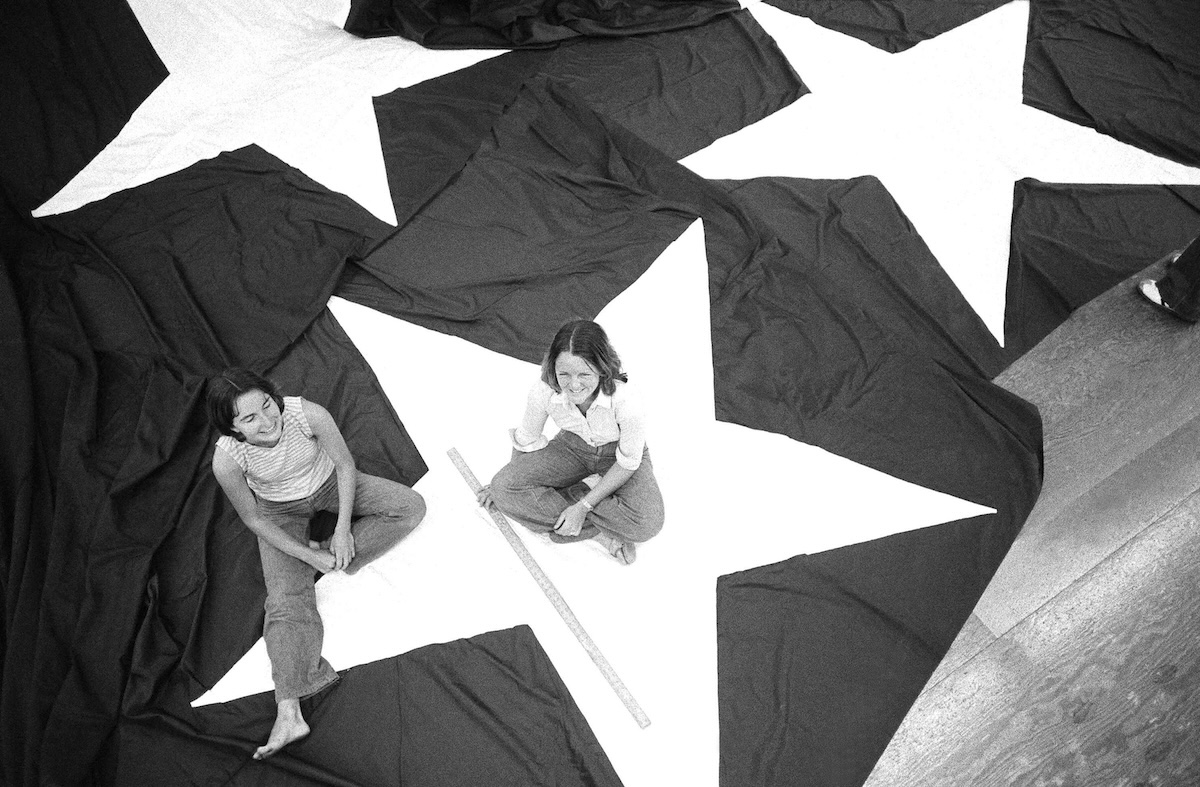
Debora Bullan, left, and Laurie Cardinale work among the stars, sewing what will become the world’s largest American flag, in Marblehead, Massachusetts, on June 15, 1976. (AP)
Was 1976 more optimistic than 2026?
In 1976, Americans weren’t necessarily optimistic; the public was concerned about the economy and foreign policy, the divorce rate was rising rapidly, race and gender became polarizing, and political corruption seemed to be endemic. But there was a feeling the worst was over, Robenalt said — that after the twin tests of Watergate and Vietnam, the guardrails of democracy and justice had held.
Political rhetoric was soothing, not caustic. After taking office, Ford assured the nation that “our long national nightmare is over.” In his acceptance speech at the 1976 Democratic convention, Jimmy Carter, who would go on to defeat Ford, said, “I say to you that our nation’s best is still ahead.”
Historians say that while Trump often sows division, the mood in 2026 doesn’t stem entirely from him. Today, there’s a more complex understanding of history — partially accelerated by bicentennial-era research — that incorporates diverse perspectives. One of those perspectives won the 2020 Pulitzer Prize for commentary — the 1619 Project, whose title referred to the year when slavery started in what would become the United States.
The project, which the Pulitzer citation called “sweeping” and “provocative,” said it aimed to “reframe the country’s history by placing the consequences of slavery and the contributions of black Americans at the very center of our national narrative.” This meant it challenged the traditional framing of the American experiment in 1776. Some prominent historians argued that it made errors of fact, and it sparked an intense, and sometimes ideologically charged, debate over what should constitute the dominant theme of America’s founding.
The sharp debate in recent years stands in contrast to 1976, a period when “the founding was less divisive,” said Kermit Roosevelt, a University of Pennsylvania law professor and author.
One irony of the 2026 celebration, Rymsza-Pawlowska said, is that many of its best offerings rely heavily on infrastructure created for the 1976 bicentennial that have now become institutionalized — local history organizations, libraries, academic research centers and graduate scholarships.
“It is no coincidence,” she wrote, “that so many public history institutions and initiatives were founded in the mid-1970s; this is a result of both the excitement and the opportunities afforded by the commemoration.”


