
What to know about Trump cryptocurrency and security
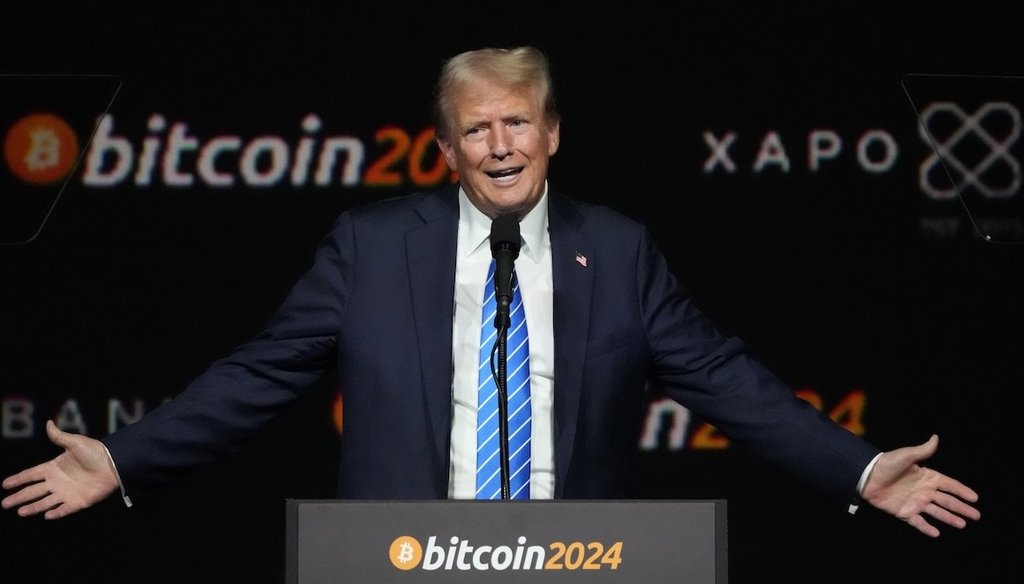
Days before his 2025 inauguration, President Donald Trump announced the launch of his meme coin, a form of cryptocurrency.
Sen. Chris Murphy, D-Conn., recently said it could be used for illicit purposes.
He posted April 9 on X: “The U.S. President is running a backdoor bribery scheme in which any CEO or foreign oligarch can send him money secretly through his crypto coin scam in exchange for favors.”
Sen. Bernie Sanders, I-Vt., echoed that idea during an April 9 CNN town hall, saying Trump “makes money by selling coins, crypto coins,” and “anybody can contribute, which is a direct line to the president.”
Legal experts told PolitiFact it’s possible, but there’s no evidence it has happened.
Sign up for PolitiFact texts
White House spokesperson Anna Kelly told PolitiFact, “The President’s assets are in a trust managed by his children. There are no conflicts of interest.” The Washington Post reported after Trump’s 2024 presidential win that, unlike in 2017 when he sold off all his stock before taking office, Trump has not taken action to “avoid financially benefiting from being president.” He also owns a multibillion dollar stake in his social media company.
Cryptocurrency is a digital asset with monetary value that can be traded without using an intermediary, such as a bank. It is promoted as an alternative to traditional financial markets. Trump and his family have launched multiple cryptocurrency projects.
Cryptocurrency transactions are validated through blockchain technology, which functions as a ledger that runs on computer servers worldwide. The nature of cryptocurrency allows anonymous investments, so anyone in the world can buy Trump’s cryptocurrency tokens while concealing their identity.
When contacted for comment, Murphy spokesperson Deni Kamper referred PolitiFact to news articles about Trump’s meme coins and the potential for bribery and fraud.
Sanders’ press secretary Patrick Quesada also referred PolitiFact to reporting on the Trump family’s cryptocurrency ventures. “Purchasing or investing in these cryptocurrencies directly benefits the Trump family and Trump himself,” he said.
Frank Emmert, an Indiana University law professor who teaches blockchain and digital currency law, said, “The transactions can clearly facilitate donations that exceed the legal (campaign contribution) limits for U.S. citizens and U.S. corporations, and they can facilitate donations by foreigners,” which are illegal.
“I am not saying that that is happening. I’m just saying it could happen, right? And if it does happen, it should be traced, because these things are then illegal,” he said. Emmert said it is possible to trace cryptocurrency transactions and it’s typically been done by specialized Federal Bureau of Investigation units.
Richard Painter, a University of Minnesota corporate law professor who served as chief ethics lawyer for former President George W. Bush, said, “I would prefer that elected officials not be trading crypto.” He added, “It can be used to pay bribes or receive government payments from foreign governments.”
What are Trump’s cryptocurrency projects? How do they work?
Trump launched $Trump, a “meme coin” or a “digital asset based on a meme.” The Associated Press described meme coins as “a strange and highly volatile corner of the crypto industry that often start as a joke with no real value but can surge in price if enough people are willing to buy them,” citing dogecoin, a meme coin based on the Shiba Inu meme, as a high-profile example. The name of Trump’s Department of Government Efficiency, called DOGE for short and led by Elon Musk, is “a nod to Musk’s support” for dogecoin, CBS News reported.
Forbes, citing a blockchain consultancy, reported that “meme coins are 50 times more volatile than Bitcoin, and hotbeds for fraud.” The Security and Exchange Commission’s Division of Corporation Finance says meme coins “have limited or no use or functionality.”
After the $Trump launch, first lady Melania Trump also launched her own meme coin called $Melania. “Basically, these two are selling computer code for money,” Emmert said. “They can multiply this computer code like you can copy paste text in a message, so it costs them nothing.”
He said people would buy the Trump meme coins either for speculative purposes — with the belief that the price will go up and therefore generate profit — or to channel money to the president. Emmert said the volatile nature of meme coins means buyers get “no value in return.”
When Trump’s meme coin launched, its value increased from $7 to $75 in a day. Today, the value of $Trump is about $8. Meme coin creators often promote their tokens and wait for profit-generating sales before selling them, driving the price back down.
According to the Trump meme coin website, CIC Digital LLC and Fight Fight Fight LLC collectively own 80% of the Trump memes. CIC Digital LLC is an affiliate of the Trump Organization, and media reported that Fight Fight Fight LLC is also a Trump Organization subsidiary.
The coins are just one of the cryptocurrency ventures linked to Trump. An entity affiliated with the Trump family called DT Marks DEFI LLC owns a 60% stake in World Liberty Financial, a decentralized finance venture that allows investors to earn and borrow cryptocurrency.
Who regulates cryptocurrency transactions?
U.S. law restricts donations to politicians. Under the Federal Election Campaign Act, individuals can donate $3,500 to a candidate per election. The 2010 Citizens United U.S. Supreme Court decision allows corporations to donate unlimited amounts to super political action committees that aren’t directly affiliated with candidates. People who are neither U.S. citizens nor green card holders are prohibited from donating to American politicians.
These restrictions could be circumvented with the Trump meme coins, Emmert said.
Since Trump took office, the Justice Department has moved to ease federal cryptocurrency prosecution. In an April 7 memo, Deputy Attorney General Todd Blanche said the Justice Department “will no longer pursue litigation or enforcement actions” involving digital assets that are more suited for regulators. The same memo said the National Cryptocurrency Enforcement Team — which included attorneys with cryptocurrency, cybercrime, money laundering and forfeiture backgrounds tasked to investigate and pursue cases of criminal use of digital assets — was disbanded.
PolitiFact researcher Caryn Baird contributed to this report.


